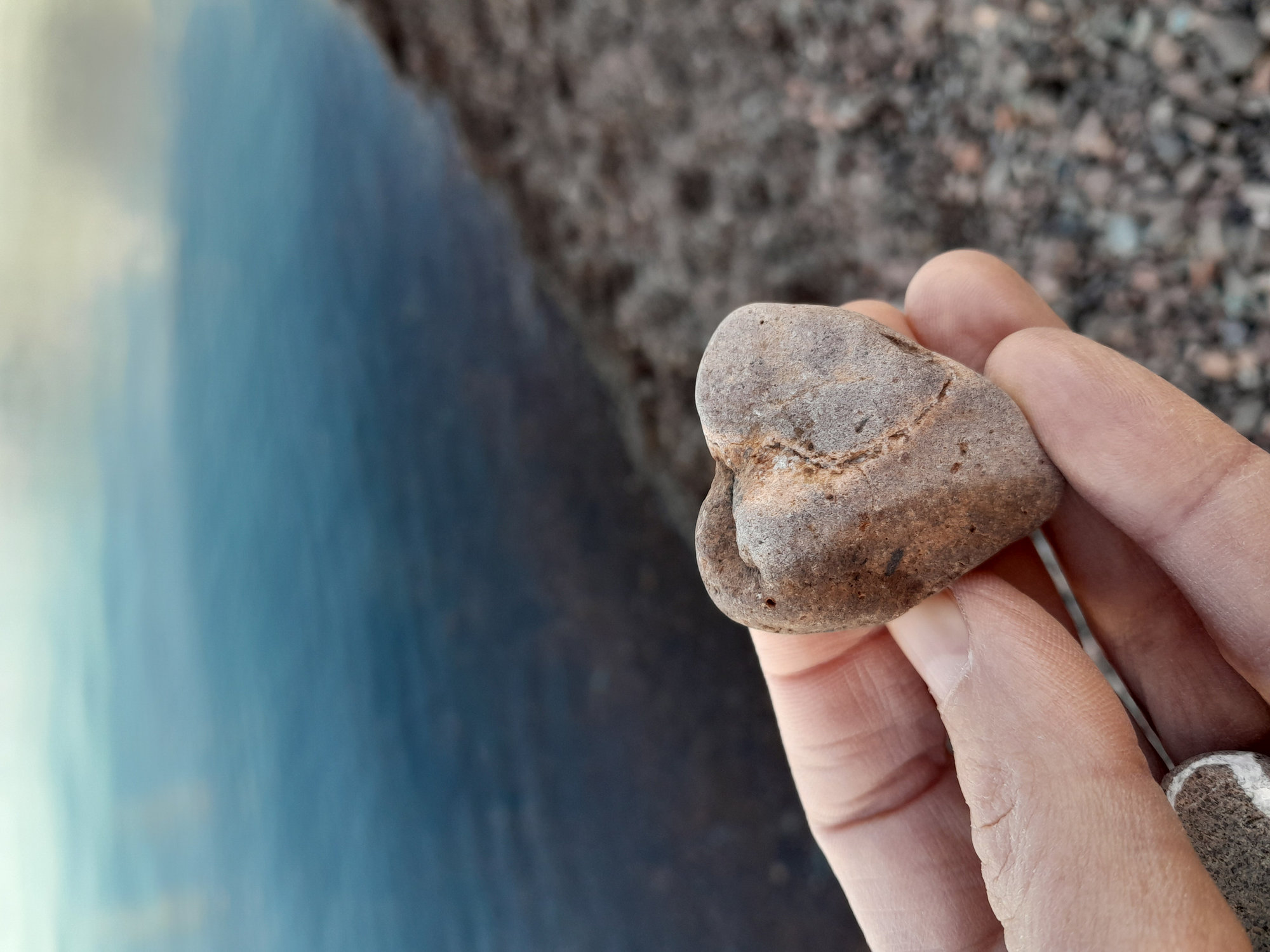
Heart stone I found while walking along the north shore of Lake Superior. |
Dear Empowered Reader,
When the poet Ross Gay decided to write a short essay about something delightful every day for a year, he expected the practice to be about finding delight. What he reported instead was that the more closely he attended, the more there was to find. The delights hadn’t increased. His attention had deepened.
I’ve been thinking about that as November arrives with its usual instruction: list what you’re grateful for.
Here is my question for you this month: Is your gratitude actually landing, or is it skipping the surface?
A flat stone thrown across a lake touches the water again and again and never goes in. That’s what a lot of gratitude practice becomes: family, health, coffee, home. Every item true, every item a stone that never sinks.
I have shared in the past a hard moment for me, and the business occurred in 2022, less than a year into owning a business. In the spring of 2022, my co-founder stepped away from Empower Possible. I found out after they stopped coming to our weekly meetings and missed a customer meeting. I called them wanting to check in, and they shared they would have to step away from the business.
In the weeks after, I did what I’d been taught to do. I made a list. Grateful for the platform. Grateful for the work. Grateful for my mentor. Every line was true. None of it landed. What did land was when a friend shared her belief in me and said You can keep going, she said, "You'll learn what you need to learn when you need to learn it; you don't need to know everything all at once." This was a huge relief. I felt overwhelmed by all that I didn't know, but I forgot that I know a lot and will learn what I don't know as I go along. I felt so grateful in that moment. It wasn’t a bigger blessing than anything on my list. It was just specific, and it happened between two people. That’s the difference I want to explore with you.
What the research says (and doesn’t) The landmark study is Emmons and McCullough’s 2003 experiment, in which people who regularly wrote about what they were grateful for reported better well-being than those who wrote about hassles.¹ The idea took off, but later work has been more sober. A 2016 meta-analysis found small effects and urged tempered enthusiasm,² and a 2021 meta-analysis found gratitude interventions had modest effects on depression and anxiety.³ The research also offers clues about what makes gratitude work: - Novelty matters. In one well-known study, people who counted blessings once a week benefited more than those who did it three times a week. Doing it too often seemed to turn it into routine.⁴
- Relationship matters. Algoe’s research suggests gratitude helps us notice, remember, and bond with the people who care for us.⁵ A 2023 meta-analysis of expressed gratitude (telling the person, not just noting it) found a significant positive effect on well-being.⁶
- People underestimate the impact. Kumar and Epley found that those who write gratitude letters consistently underestimate how much the recipient will be moved.⁷
Put simply, the practice works best when it is specific, fresh, and shared.
Gratitude can quietly become a way to avoid. When a list of “shoulds” arrives faster than the feeling does, we can skip right past grief, disappointment, or ambivalence. We perform appreciation for what’s supposed to move us instead of noticing what actually does. Emotional precision isn’t about feeling more grateful. It’s about knowing what moved you, where you felt it, and who was there.
Applying it In your life and your leadership, ask whether your thanks reaches the person or just the page. “Great job this quarter” is a stone. “When you stayed late to walk Marcus through the handoff, I saw the whole team exhale” goes in. |
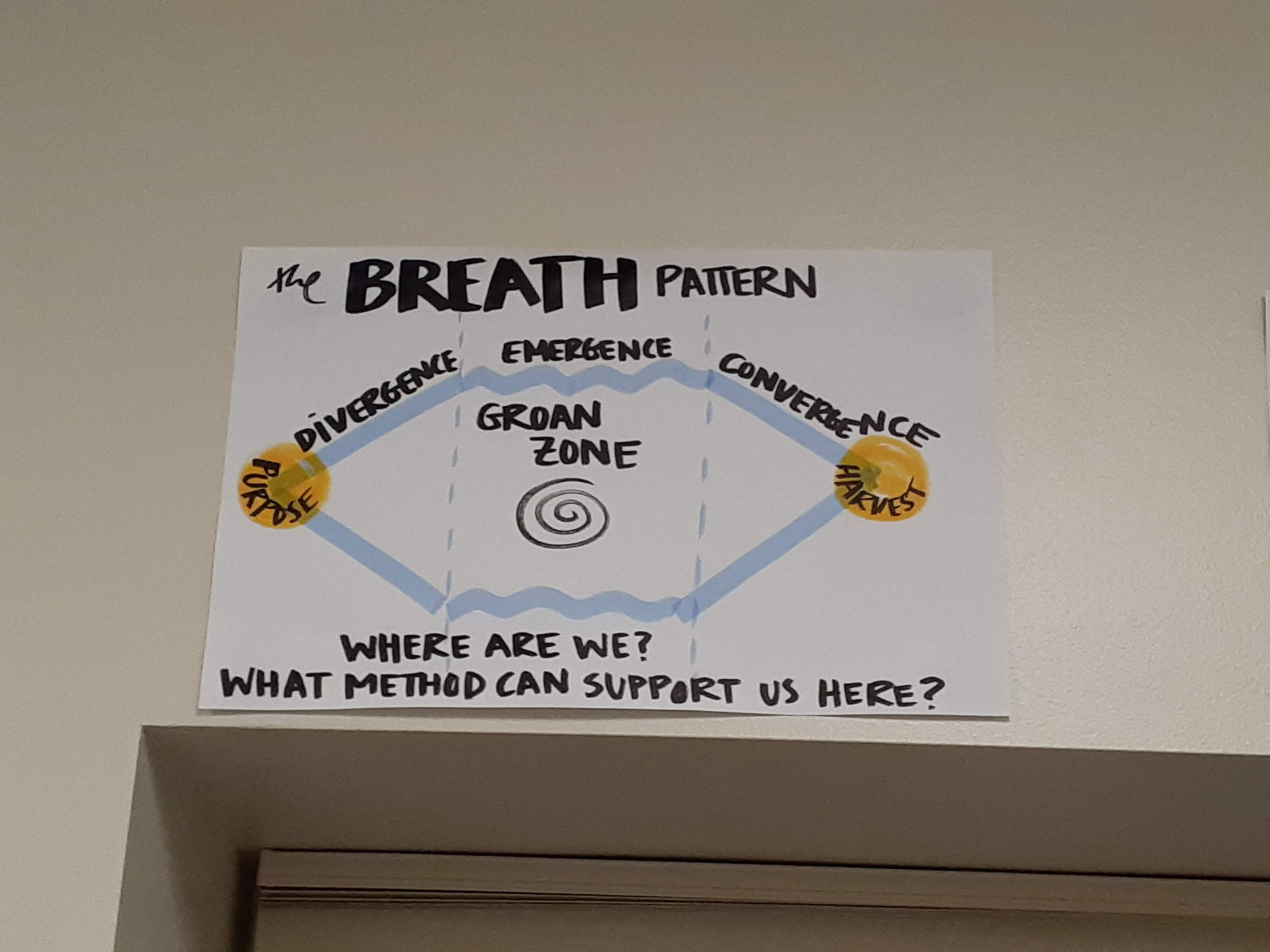
The Breath Pattern: we open up, we move through the messy middle, and we land. |
I keep a photo of a hand-drawn poster called The Breath Pattern. It maps how a group moves from purpose, to opening up (divergence), through the uncomfortable middle it calls the Groan Zone, and finally to convergence and harvest.
A gratitude list lives in divergence. We open wide and name everything: family, health, coffee. The groan zone is where it gets harder, because the question shifts from what could I be grateful for? to what actually moves me? That’s where we’re tempted to skip back to the list. But the harvest, the thing that lands, only comes after we’ve stayed in the middle long enough to get specific.
The poster asks two questions I’d offer you this month: Where are we? What method can support us here?
|
An affirmation for the month I let gratitude be specific, and I let it be felt.
A practice: The Three-Minute Landing - Choose one person, not a category.
- Recall one specific moment, with a place and a detail.
- Pause and notice where you feel it in your body. Warmth in the chest, a loosening in the shoulders, tears.
- Name what it moved in you (relief, safety, being seen), not just that you’re thankful.
- Tell them, in a sentence or two, by text, note, or in person.
Try completing this activity at least once a week.
Reflection questions - What am I genuinely moved by right now, rather than what I think I should appreciate?
- Where is my gratitude skipping the surface, and what might it be skipping past?
- Who needs to hear the specific thing I’ve only ever thought generally?
- What am I not allowing myself to feel because I’m busy being grateful?
Take care, dear reader,
Julie
Sources - Emmons, R. A., & McCullough, M. E. (2003). Counting blessings versus burdens. Journal of Personality and Social Psychology, 84(2), 377–389.
- Davis, D. E., et al. (2016). Thankful for the little things: A meta-analysis of gratitude interventions. Journal of Counseling Psychology, 63(1), 20–31.
- Cregg, D. R., & Cheavens, J. S. (2021). Gratitude interventions: Effective self-help? Journal of Happiness Studies, 22(1), 413–445.
- Lyubomirsky, S., Sheldon, K. M., & Schkade, D. (2005). Pursuing happiness: The architecture of sustainable change. Review of General Psychology, 9(2), 111–131.
- Algoe, S. B. (2012). Find, remind, and bind. Social and Personality Psychology Compass, 6(6), 455–469.
- The effect of expressed gratitude interventions on psychological wellbeing: A meta-analysis of randomised controlled studies. International Journal of Applied Positive Psychology, 8, 63–86 (2023).
- Kumar, A., & Epley, N. (2018). Undervaluing gratitude. Psychological Science, 29(9), 1423–1435.
- Gay, R. (2019). The Book of Delights. Algonquin Books.
|
Gratitude that lands doesn’t skim. It ripples. |
“Messenger” by Mary Oliver |
My work is loving the world.
Here the sunflowers, there the hummingbird—
equal seekers of sweetness.
Here the quickening yeast; there the blue plums.
Here the clam deep in the speckled sand. Are my boots old? Is my coat torn?
Am I no longer young, and still half-perfect? Let me
keep my mind on what matters,
which is my work,...... Read the rest at https://wordsfortheyear.com/2020/04/04/messenger-by-mary-oliver/
|
|
|
|